
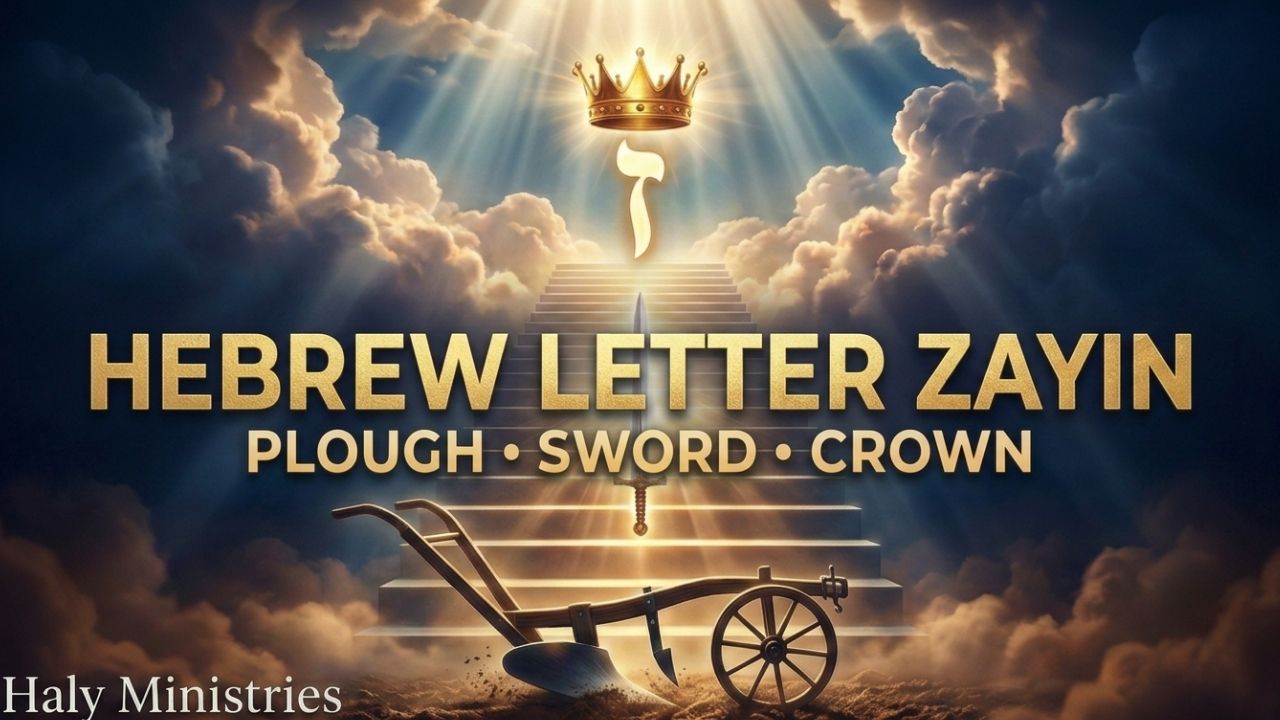
The Hebrew letter Zayin (ז) is the seventh letter of the Hebrew alphabet. Its number value is seven. Its ancient pictograph is often interpreted as a plough, the kind of tool a farmer drags through hard, unbroken ground so a seed has somewhere to go. And the moment you understand what a plough was actually built to do, you will stop seeing the seasons that broke ground in your life as only damage.
The keyword most people search for when they find this article is simple: Hebrew letter Zayin. But what God has to say through this letter is not simple at all.
It is a word about ground that had to be broken before it could hold anything. It is a word about a tool that cuts, not to destroy, but to plant. And by the end, it is a word about a sword too, because the two are closer than you think.
I want to share something with you before we go further into the meaning of Zayin. Because I believe most of us are standing on ground that has just been ploughed, wondering why it had to hurt this much to get us here.
What Does the Hebrew Letter Zayin Mean?
Behind many Hebrew letters sits an old picture, not just a sound. These ancient letter pictures have been explored in Jewish and Christian traditions, and they still carry weight for many believers today.
The image behind Zayin is often read as a plough, or a related farming tool. And the Hebrew word zayin itself means “weapon” in Mishnaic Hebrew.
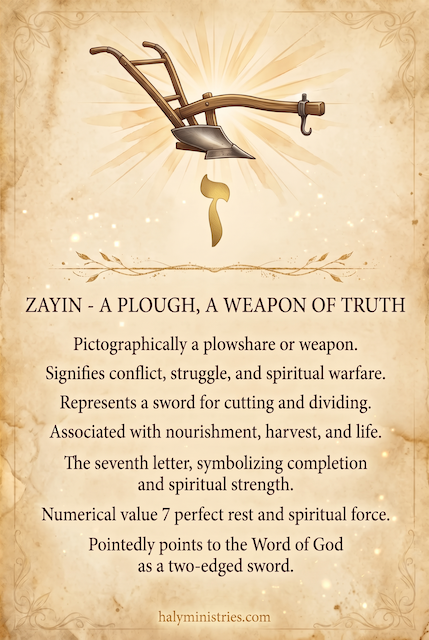
A farming tool, and a weapon. The tool that opens the ground and the weapon that protects it have more in common than they first appear.
Zayin is the letter of the instrument that goes into hard ground first. Not to ruin it, but to make it able to carry a harvest.
Think about what unbroken ground actually is. Hard. Closed. Nothing can take root in it as it is.
A plough does not politely ask that ground to soften. It cuts straight through it, turns it over, and exposes what was buried underneath to air and light for the first time.
It sounds harsh for something whose whole purpose is to feed a family. But that is Zayin. The breaking and the feeding are not two different things. They are the same thing, and I think that is exactly the point.
The Three Forms of Zayin: From Plough to Crown
Hebrew letters did not stay the same shape across history, and Zayin carries three readings worth walking through together.
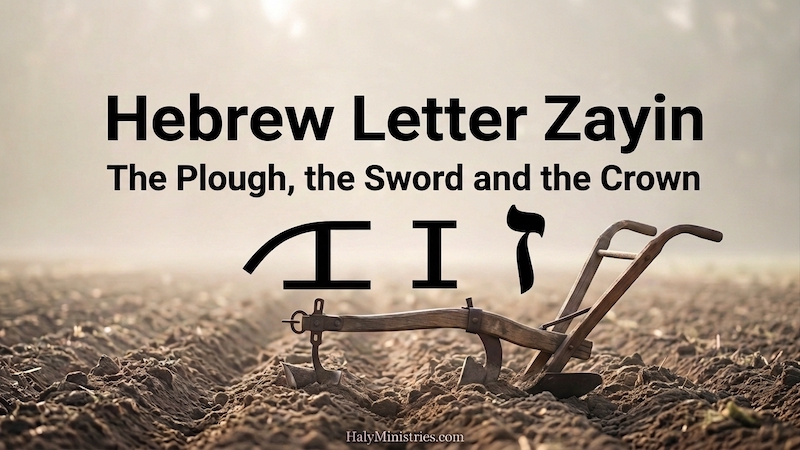
The pictograph, the oldest layer, is interpreted as a plough or farming implement. The tool that breaks ground so something can be planted.
Then the picture changes.
In one of the earliest forms of Hebrew writing, Zayin appears as a simple vertical stroke with a short bar near the top – something that can be seen as a blade set upon a handle. And there is something significant here: the name Zayin itself means “weapon” or “sword.”
The plough becomes a weapon.
First, the tool that breaks open the ground. Then, the weapon that guards what has been planted. What begins in the field moves to the battlefield.
And finally, we come to the familiar Hebrew letter ז, used in Scripture and in Hebrew today. Its shape has been understood as a Vav wearing a crown.
The plough. The weapon. The crown.
Three pictures. One letter. A progression worth paying attention to.
Zayin and the Number Seven
As the seventh letter, Zayin carries the weight of the number seven throughout Scripture. Seven is the number of completion.
God rested on the seventh day, not because He was tired, but because the work was finished. Seven shows up again and again at the end of something, marking it as whole.
But here is what is easy to miss. A harvest never comes before the ploughing. It comes after it.
The rest of the seventh day comes after six days of work. In the same way, harvest comes after the ground has been broken open.
Zayin sits at that exact hinge point. It is the letter that says the ground was cut open on purpose, so that something could grow there and eventually be brought in.
Seven is not the reward for staying untouched. It is the reward for ground that let itself be broken so something could grow.
If you are in a season that feels like being cut open right now, plans turned over, comfort disturbed, things exposed that used to stay hidden, Zayin says this is not random. It is what happens to ground right before it becomes able to carry something it never could have carried while it stayed hard and closed.
The Plough God Chose: What This Tool Reveals About You
God did not have to picture this letter as a plough. He could have chosen something gentler, a tool with no edge at all.
But He chose the instrument farmers trusted with the one piece of ground their whole household depended on. Once you understand how that tool actually worked, you will understand something about how the hard ground in your own life has been working too.
Here are some things a plough does. Read them slowly. Every one of them also gives us a picture of you.
1. The Cut
What it does: A plough’s blade goes into ground that has never been opened, cutting a line straight through whatever has hardened there, weeds, roots, packed earth, all of it.
What it means for you: What has been cut into recently, a relationship, a plan, a comfort you had settled into, was not cut at random. Something needed a straight line through it before anything new could be planted there.
2. The Turning
What it does: The blade does not just cut. It lifts the soil and turns it over, bringing what was buried underneath up to the surface, and pushing what was on top down and under.
What it means for you: Seasons that feel like everything is being turned upside down are not only chaos. Whatever has been hidden in you is being brought up where it can finally be seen and dealt with, and whatever has been sitting on top, unused, is being pressed down where it can finally do some good.
3. The Depth
What it does: A shallow furrow produces a shallow crop. The deeper the plough cuts, the deeper the roots of whatever is planted will be able to grow.
What it means for you: The depth of what you are walking through right now is not excessive. It is proportional to the depth of root God is preparing you to hold. Shallow ground grows things that blow over in the first storm.
That does not mean every hard season was sent to teach you a lesson, or that pain by itself proves you were chosen for something greater. It simply means nothing you surrender to God in that depth goes to waste.
4. The Weight
What it does: A plough only cuts as deep as the weight pressing down on it. Too light, and it skims the surface without breaking anything open.
What it means for you: I do not believe every weight you carry was sent by God to crush you, or measured out on purpose to break you open. Some of it is simply the weight of living in a broken world.
But wherever that weight has come from, God can still use it. Pressure that would have left lighter ground untouched can, in His hands, be the very thing that lets something take root.
5. The Season
What it does: Ploughing belongs to the season before planting. It is not the work of the whole growing season. A field that was ploughed and sown does not get ploughed again mid-season, or it would destroy what is growing.
What it means for you: This breaking open is not permanent and it is not going to happen forever. It has a season. Once the ground has been cut and turned and something has been planted, the ploughing stops and the growing begins.
6. The Harvest
What it does: Every part of the process, the cutting, the turning, the depth, the weight, exists for one reason only, so that ground that could not have produced anything on its own becomes able to feed a household.
What it means for you: None of what has been done to you was the point on its own. It was always in service of what you will be able to carry and produce afterward. The cutting was never the goal. The harvest was.
He did not break the ground to leave it broken. He broke it because He intended to plant something there.
That is Zayin. Ground that let itself be opened, and a harvest that could not have come any other way.
Zayin in Psalm 119: Remember Your Word
In Psalm 119, the longest chapter in the Bible, each section is dedicated to a Hebrew letter. The Zayin section covers verses 49 to 56, and the theme is remembrance in the middle of affliction.
“Remember your word to your servant, for you have given me hope.” Psalm 119:49
This is Zayin as the word held onto while the ground is still being turned. Not a word remembered once things have settled, but a word gripped tightly while the blade is still moving.
The psalmist is not writing from a finished harvest. He is writing from the middle of affliction, and what he reaches for is not comfort. It is a promise he was already given.
The prayer of Zayin is not, Lord, stop the ploughing. It is, Lord, remind me of what You already said, because I need it right now while the ground is still being broken.
For more on how Zayin appears throughout the Hebrew Scriptures, the scholars at BibleHub provide a helpful reference on the Hebrew alphabet and its meanings.
The Plough Becomes a Sword
The picture does not stop at the plough. Scripture itself holds the plough and the sword side by side, a ploughshare beaten into a blade, a tool of provision turned into a weapon when the moment demanded it.
I do not need history to prove these were ever literally the same object to see what that image is saying. The purpose changes, from feeding a household to defending one, and Zayin carries both pictures at once.
The writer of Hebrews tells us the word of God is living and active, sharper than any two-edged sword, able to divide soul from spirit, joint from marrow, and to judge the thoughts and intentions of the heart. Paul calls it the sword of the Spirit. That same word is also, in the same breath as Zayin, the tool that broke open the ground of your life so something could be planted there.
The blade that cuts you open and the blade that defends what grows in you are not two different things. They are the same tool, held for two different purposes, in the same faithful hand.
And Then I See Jesus
And this is where, for me, Zayin stops being only a picture and becomes personal. Because who is the One who takes the plough and walks the ground? Jesus.
He is not standing somewhere at the end of this story, waiting for us to arrive at the crown. He is with us in the field.
Jesus spoke about putting your hand to the plough and not looking back. He knows what it means to move forward when the ground is hard and the way ahead costs something.
And then we come to the sword. Jesus is the Word. John tells us, “In the beginning was the Word,” and that the Word became flesh. The Word that cuts, exposes, separates and brings truth is not simply an idea. He is a Person.
When I look at Zayin, I see more than a plough, more than a sword and more than a crown. I see Christ:
- The One who leads us into the field.
- The One who is the Word.
- The One who teaches us how to stand.
- The King who wears the crown and reigns.
The plough. The sword. The crown. And at the centre of all three is Jesus.
The Sword Becomes a Crown
The picture completes itself here, in the modern letter’s shape. A sword is not the final form of Zayin. A crown is.
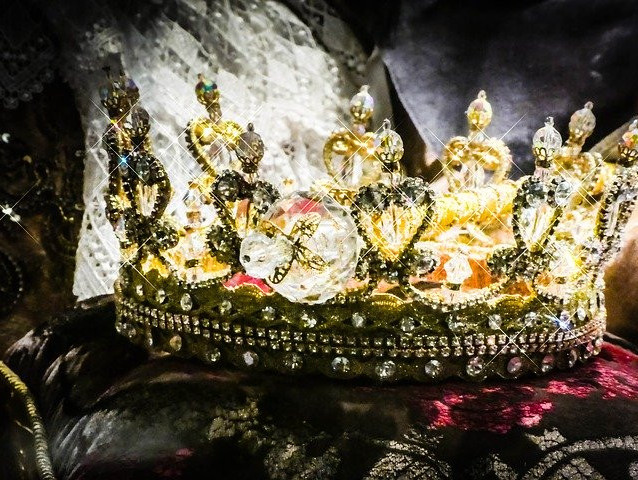
Go back to what a sword was for in the first place. Nobody picks one up to keep fighting forever. A sword is drawn to end a threat, to defend what was worth defending, to finish something that needed finishing.
Once that work is done, the sword does not stay raised. It rests. And in Scripture, the one who carried the blade faithfully through the fight is the one who is given the crown, not instead of the sword, but because of what the sword accomplished in his hand.
This is the picture I keep coming back to. Ground broken open by a plough. A blade drawn when the ground needed defending.
And then, once the fight is finished, that same shape settles into the form of a crowned man. Not a different tool for a different person. The same letter, the same struggle, worn differently once it is over.
He does not hand you a crown instead of the sword. He hands you the crown because of what you carried the sword through.
If you are still holding the blade right now, still in the ploughing, still in the fight, this is not a promise that skips ahead of you. It is a promise about where the letter ends. Zayin does not stop at struggle. It leads us to the King, to the Messiah.
My Own Zayin Season
I am living inside this picture right now, not looking back on it from a safe distance.
A chapter I had lived and worked in for many years, in a place that had become far more than a workplace to me, came to an unexpected end.
It was where I had stability. It was where I welcomed and cared for people for years. And then, without much warning, that chapter closed.
There were tears. There were questions. I loved that season, and I do not regret a single year of it.
But looking at it honestly, it had become cosy in a way that was hard to name at the time. Comfortable enough that I could have stayed.
And yet underneath that comfort, there was always something unsettled in me too, a quiet knowing that I would not be there forever, even on the ordinary days when nothing was wrong at all.
So the blade went back in. Not because that season failed, and not because the ground had gone bad. It had simply become the kind of comfortable that can quietly become a wall if you stay inside it too long, however gently it was built.
Alongside the grief of that ending, I have felt something steady underneath it, a real peace, because I recognise what this is now. This is not an ending with no direction. This is preparation.
God has already been laying groundwork for what is ahead of me, and this ploughing is part of how He gets the ground ready to carry it. I do not need to know every detail of the next chapter to know that one is being formed.
The furrow being cut through my life right now is not random. It is deliberate, and it is aimed at something greater than what I am leaving behind.
You can read the fuller story of that season here: Made Redundant, What Now? A New Chapter Begins
What Zayin Is Saying to You Right Now
Maybe something in your life has been turned over that you did not choose. A relationship, a role, a plan you had for how this year was supposed to go.
Maybe you feel exposed, like things that used to stay buried are suddenly visible, and you are wondering why it had to happen this way.
I want to be honest with you here too. Not everything that has been turned over in your life was something God reached in and caused. We live in a broken world, and people make choices, and doors close for reasons that have nothing to do with a lesson you were meant to learn.
But even there, God does not waste what He did not cause. He is able to take what you never chose and still bring a harvest out of it.
Zayin does not say the breaking was a mistake. Zayin says the breaking was ploughing. Ground is not damaged by being cut open and turned. It is made ready by it.
What feels like loss right now may be the exact preparation that lets something take root deep enough to survive what comes next.
What has been turned over in you was never disturbed without purpose. It was ground being made ready for a harvest.
God is not finished with this field. He is not surprised by how deep the blade has gone.
He sees every furrow, and He is not asking you to enjoy the cutting. He is asking you to trust that no one ploughs ground they do not intend to plant.
A Declaration for Your Zayin Season
Speak this over yourself today:
I was not cut open without purpose. This ground has been broken so something could take root in me, not to leave me exposed forever. What has been turned over in me is being made ready, not wasted. I carry what God has planted in this ground, and I will not despise the blade that opened it. I am being prepared for a harvest greater than the pain of this season. And what was once used to break me open will one day defend what has grown here. In Jesus’ name.
If this word has spoken to your season, leave a comment below. I read every one. And if you know someone whose ground is being broken open right now, send this to them today. They need to know the ploughing is not the end of the story.
With love and faith for your next season,
Haly
Continue the Journey:
- Hebrew Year 5787: Your Season of Victory, for more on why this year carries this letter’s weight
- Hebrew Letter Gimel: The Camel, the Burden and the Blessing
- Hebrew Letter Dalet: Exploring Its Christian Significance
- Hebrew Letter Bet: Exploring Its Christian Significance
- Hebrew Letter Aleph, What Does It Mean?
Haly, I just came across your site and the depth of it is beautiful & incredible. I have sat under a messianic Rabbi for decades now and was searching for the significance of the letters for the 2027 Hebrew new year. So much of your articulation for 5787 resonated in my spirit, especially the decluttering – something the spirit has been whispering into my heart. The truth, you unpacked of the plow/cutting, sword/protection and the crown brought great encouragement, igniting the resolution to continue the work of scribing His Heart for the Bride which He’s called me to. An arduous task of decades of journaling & revelations of The Word of God. Although my hair has long been silver, His purpose sees beyond my age, the hours of ministry I am engaged in & encourages me to press on. From my heart, thank you and God‘s peace to you, and may His Face shine on you, to shine like the stars.
Hello Cathy,
Thank you for writing, and for sharing your heart so openly – it blessed me deeply.
It is no small thing that decades under a messianic Rabbi, decades of journaling and receiving revelation, would lead you to a page written for 5787 and find so much of it already stirring in your spirit. That is the Lord confirming what He has already been whispering to you: the decluttering, the plow, the sword, the crown and none of that was new information for you. It was recognition. He was simply using the article to say “yes, keep going, you heard Me right.”
The Lord does not measure calling by age. He measures it by faithfulness, and yours has clearly been proven over decades. Please PRESS ON. The Bride needs what you have been given to write.
Thank you for your blessing over me. I receive it, and I pray the same over you: that His face shines on you and that you continue to shine to this broken world that needs your words.
With love and gratitude,
Haly